
The Federation of Indian Pilots (FIP) has urged the government to order a judicial probe into the Air India Dreamliner crash that killed 260 people, alleging that the ongoing investigation is "compromised" and should be halted.

The Supreme Court has put on hold the Uttar Pradesh government's plan to develop the Shri Banke Bihari Temple Corridor in Vrindavan, citing a lack of consultation with key stakeholders. The court questioned the state's approach and the urgency of enacting an ordinance to take over the temple's management.

The Chhattisgarh High Court has ruled that anti-Naxal operations, as part of regular counter-insurgency measures, should not be investigated by a Special Investigation Team (SIT) unless exceptional circumstances justify such intervention. The ruling came as the court dismissed a petition seeking an SIT probe into the killing of a Maoist leader in Narayanpur district.
The Supreme Court has scheduled hearings starting August 19 for the Presidential Reference concerning constitutional issues related to timelines for handling bills passed by state assemblies. The court has directed the Centre and states to submit written arguments by August 12.

The bench said, given the pressing nature of the crisis, particularly in cities like Kota, Jaipur, Sikar, Vishakhapatnam, Hyderabad, and Delhi, where students migrate in large numbers, immediate interim safeguards are the call of the day.

Bangladesh's top legal official has proposed to remove the words 'secularism' and 'socialism' from the Constitution apart from a provision prescribing capital punishment for regime change through extra-constitutional means.

The Supreme Court has expressed concerns over student suicides at IIT Kharagpur and Sharda University, directing expedited investigations into the incidents. The court questioned the institutions' handling of mental health issues and compliance with previous directives.

President Droupadi Murmu has exercised powers under Article 143(1) used in rarity to know from the Supreme Court whether timelines could be imposed by judicial orders for exercise of discretion by President while dealing with the bills passed by state assemblies.
On the admissions, he said 26 people were treated in the OPD and were discharged. And of the 67 admitted as in-patients, 2 were critical. All others were stable. One of the patients was shifted to the Madurai GH for further treatment.

The Bombay High Court ruled that possessing documents like Aadhaar, PAN, or voter ID does not automatically grant Indian citizenship, emphasizing the importance of the Citizenship Act of 1955.
The Supreme Court of India has sought the government's response on a Public Interest Litigation (PIL) that challenges the appointment process of the Comptroller and Auditor General of India (CAG), arguing it's unconstitutional. The PIL, filed by the Centre for Public Interest Litigation, claims the current process, solely through executive appointment by the Prime Minister, undermines the CAG's independence and violates constitutional principles. The court, while acknowledging the importance of institutional trust, questioned the extent to which it should intervene in the appointment process and whether this would constitute rewriting constitutional provisions. The PIL suggests the CAG's appointment should be similar to other independent bodies, with a selection committee comprising the Prime Minister, Leader of the Opposition, and Chief Justice of India. The case has implications for the independence and transparency of India's audit system.

The Supreme Court of India has ruled that religious conversions undertaken solely to avail reservation benefits without genuine belief in the adopted religion amount to "fraud on the Constitution". The court upheld a Madras High Court decision denying a scheduled caste certificate to a woman who converted to Christianity but later claimed to be a Hindu to secure employment benefits.
'Devendra Fadnavis is stating that Marathas must feel OBCs are not happy with reservations for the Marathas and therefore they are protesting.'

The Kerala High Court has suspended toll collection on the Edappally-Mannuthy stretch of NH 544, citing the failure of the NHAI to provide safe and unhindered access to the highway due to ongoing construction and poor maintenance.

Referring to the enactment of the Chhattisgarh Auxiliary Armed Police Force Act, 2011 which created a trained force to aid and assist the security forces in maintaining law and order in the state, the bench said in its view it cannot be said to be an act of contempt of the order of 2011 passed by this court.

Unless Governor Ravi or the Union of India moves in appeal, seeking a hearing by a constitutional Bench, this is where it all will have to end, observes N Sathiya Moorthy.

The Supreme Court has questioned the line of investigation adopted by the Haryana SIT in the case of an Ashoka University professor booked for social media posts, stating that it "misdirected itself."
'Anyone they don't like can be potentially arrested and thrown in jail for 30 days to induce regime change.'
The Supreme Court on Friday refused to refer pleas related to the June 2022 Maharashtra political crisis triggered by the Shiv Sena's division to a seven-judge bench for reconsideration of the 2016 Nabam Rebia judgment.
'His willingness to take the initiative to fight for truth and justice and his willingness to cross swords with anyone for a just cause.'

A bench of Justices B R Gavai and K V Viswanathan clarified that its order will not be applicable to unauthorised structures on public roads, footpaths etc.

Reliance Foundation's Vantara has pledged full cooperation with the Supreme Court-appointed SIT investigating allegations of legal non-compliance and animal acquisition irregularities.
The Supreme Court declined to examine a plea challenging a PMLA provision, stating the issue lies in the law's abuse, not the law itself. The court allowed the petitioner to approach the High Court if procedures weren't followed.
A judgment of a Constitution bench would be "binding" on benches of lesser strength, the Supreme Court has said while recalling an April 2022 verdict delivered by it.

Ask rediffGURU and tax expert Mihir Tanna your income tax-related questions.
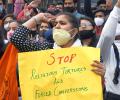
The Supreme Court has sought the Uttar Pradesh government's response on a plea challenging certain provisions of the 2024 amended UP law on unlawful religious conversion, citing concerns about free speech and religious propagation.
The Special Marriage Act, 1954 provides a legal framework for the marriage of people belonging to different religions or castes. It governs a civil marriage where the state sanctions the marriage rather than the religion.
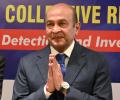
The Supreme Court questioned Justice Yashwant Varma regarding his plea to invalidate an in-house inquiry panel report that indicted him after a large amount of burnt cash was discovered at his official residence during his time as a Delhi High Court judge.
The Supreme Court is scheduled to hear a plea for the restoration of statehood to Jammu and Kashmir. The plea highlights the delay in restoration and its impact on democratic rights and development.
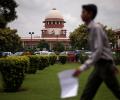
The Supreme Court has initiated a suo motu case regarding investigation agencies summoning lawyers and will examine if they can be put to notice. The action follows the Enforcement Directorate summoning senior lawyers, which was condemned by bar associations.

The Supreme Court has temporarily halted a High Court order that would have sent a decades-old property dispute involving the Bhopal royal estate back to trial court. The case involves descendants of Nawab Hamidullah Khan and challenges the inheritance of Sajida Sultan and her heirs, including actor Saif Ali Khan.
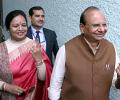
The Delhi government is embroiled in multiple litigations with the Lieutenant Governor in the Supreme Court including its plea challenging the Centre's law establishing pre-eminence of the LG over the elected dispensation in controlling services in the national capital.

'Always keep accurate and transparent records of the source of the investment or property's funding: Loan agreements, transfer records of the property, and bank statements of co-owners if available.'

A bench of Justices Surya Kant and Joymalya Bagchi is likely to take up the matter in which the EC has justified its ongoing SIR of electoral rolls in Bihar, saying it adds to the purity of the election by "weeding out ineligible persons" from the electoral rolls.

The Supreme Court has directed the Election Commission to provide details regarding the approximately 65 lakh voters removed from the draft electoral rolls in Bihar, a state preparing for elections. The court's order comes in response to a petition filed by an NGO challenging the Election Commission's Special Intensive Revision of electoral rolls.

"Considering the importance of the matter, subject to the order of the Chief Justice of India, the matter be placed for final hearing on July 22," the bench said.
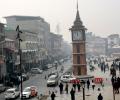
Highlights of the judgment pronounced by a five-judge Constitution bench of the Supreme Court that on Monday unanimously upheld the Centre's decision to abrogate provisions of Article 370 of the Constitution bestowing special status on the erstwhile state of Jammu and Kashmir.

Underscoring the 'presumption of genuineness' of Aadhaar and voter ID, the Supreme Court on Monday refused to stay the publication of draft electoral rolls in poll-bound Bihar and said it would once and for all decide pleas against Election Commission's special intensive revision (SIR) of electoral rolls.
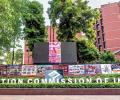
The Supreme Court will hear on February 19 pleas challenging the appointments of the Chief Election Commissioner and Election Commissioners under the 2023 law. The court will take up the matter on a priority basis, after some urgent listed matters. The government has appointed a new CEC and ECs under the new law, which excludes the Chief Justice of India from the selection panel, despite a 2023 Supreme Court verdict directing the inclusion of the CJI in the panel. The petitioners argue that the exclusion of the CJI undermines the independence of the election commission.
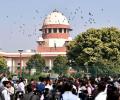
The Supreme Court has begun hearing petitions challenging the Election Commission's decision to conduct a special intensive revision exercise in Bihar ahead of elections, raising concerns about voter exclusion.
 © 2026 Rediff.com - Advertise with us - Disclaimer - Privacy Policy - Sitemap - Feedback - About us - Terms of use - Grievances